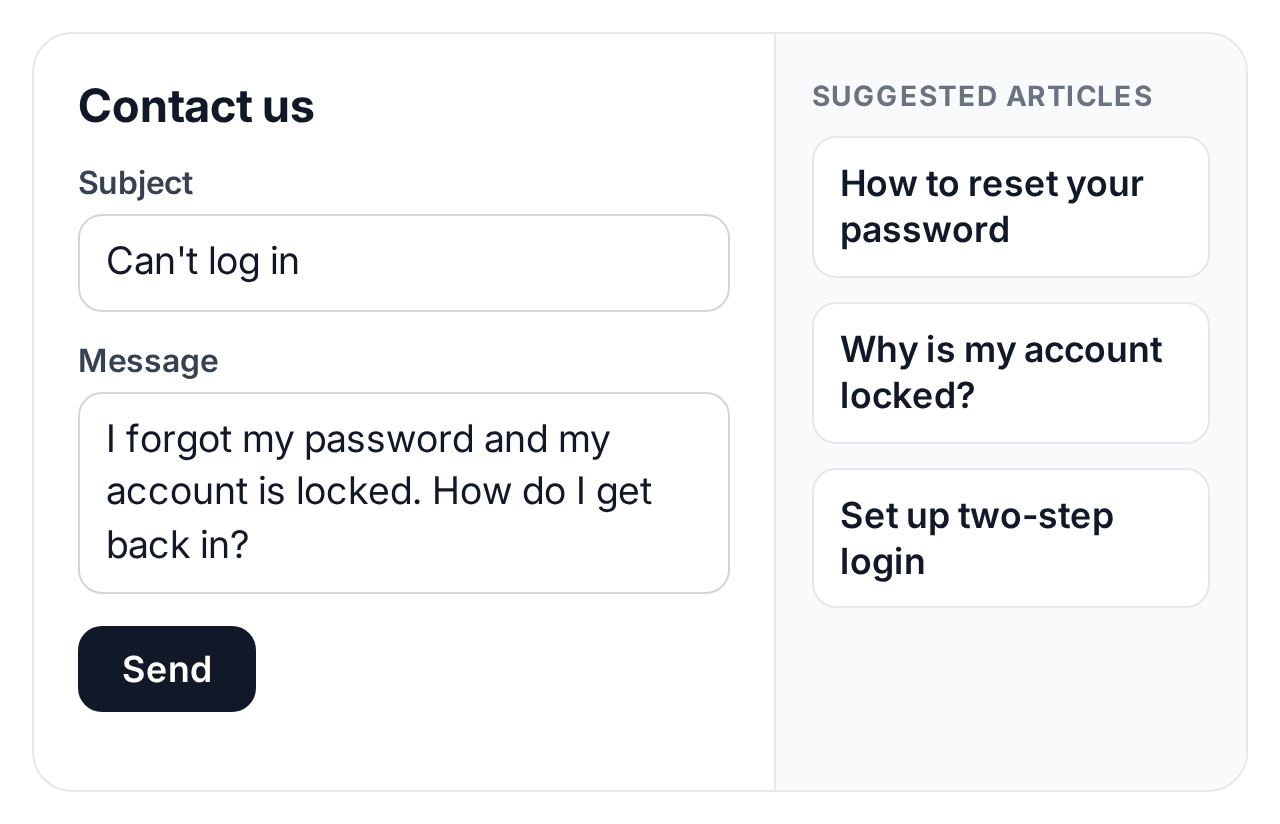
Ticket deflection shows how much of your support demand customers can handle themselves, which is often the cheapest way for a small team to grow without hiring. For example, a customer who starts writing to support about a forgotten password, opens the suggested article and never sends the form is one deflected ticket. On the phone the same idea is called call deflection, usually done with an IVR menu that offers a text link to an article or a callback.
How do you measure ticket deflection?
A widely used way to measure ticket deflection is the self-service score: divide the number of people who used your help center by the number of people who submitted a ticket in the same period.
Self-service score
A higher score means more customers look for answers themselves; it does not prove each of them solved the problem.
Example: In one month 2,400 people use your help center and 600 submit a ticket: 2,400 ÷ 600 = 4, a self-service score of 4:1.
Benchmark: There is no neutral benchmark; Zendesk's article uses 4:1 only as a worked example. Source: Zendesk, Ticket deflection (vendor article)
The self-service score shows how many people try self-service; the deflection rate shows how many of them did not need a ticket afterwards. To calculate the deflection rate, divide the self-service sessions that end without a ticket by all self-service sessions and multiply by 100.
Deflection rate
Pick the window once and keep it. Confirm a sample with a short Did this solve your problem? question, because a customer who leaves without an answer also opens no ticket.
Example: Of 1,000 help center and chatbot sessions in a month, 300 end without a ticket from the same customer within 24 hours: 300 ÷ 1,000 × 100 = 30% (example numbers, not a benchmark).
Why does ticket deflection matter?
Ticket deflection matters because most customers prefer to help themselves first: a 2017 Harvard Business Review article by Matthew Dixon and colleagues reports that 81% of customers across industries try to take care of matters themselves before reaching out to a live representative.
- Faster answers. A good article answers at 2 a.m. without anyone waiting for a reply.
- Time for harder requests. Every password question solved in self-service leaves agents time for problems that need a person.
- Growth without hiring. Self-service handles more volume as the customer base grows; a small team can stay small for longer.
- Better content signals. Searches that end in a ticket show exactly which article is missing or unclear.
What are the ways to deflect support tickets?
Support teams deflect tickets by putting answers where customers already look: in the help center, in the contact form and in chat:
| Channel | How it deflects | Works best for |
|---|---|---|
| Knowledge base | Articles customers find through search or links | How-to questions, setup steps, policies |
| Article suggestions in the contact form | Suggested articles appear next to the form before the customer sends it | Questions asked often, with one clear answer |
| Search widget on your website | Searches your articles from any page, without leaving it | Product and pricing pages where questions start |
| AI chatbot | Answers in chat from your articles and hands over to a person | Simple questions outside office hours |
| Community forum | Customers answer each other, and answers stay searchable | Products with many experienced users |
| Proactive notices | A status page or order email answers the question before it is asked | Outages, shipping, known issues |
How can a small support team start deflecting tickets?
A small team starts by writing articles for its most frequent questions and showing them where customers are about to contact support.
-
Find the top ten questions
Tag a few weeks of tickets by topic and list the questions that come back most often.
-
Write one clear article each
Answer each question completely, with steps and screenshots, in the words customers use when they ask.
-
Show articles where customers ask
Link them from the contact form, the chat window and your product pages, so the answer appears before the ticket.
Measure and update monthly
Check which topics still arrive as tickets and which searches find nothing, then fix or add those articles.
How does AI ticket deflection work?
AI ticket deflection uses a chatbot or AI agent that answers in its own words from your help articles instead of listing links; count a request as deflected only when the customer confirms the answer and no ticket follows within your window.
- Answers come from your content. The AI is only as good as the articles it reads, so keep them current.
- Hand-over must be easy. Customers who need a person should reach one in one step, with the conversation passed along.
- Wrong answers cost more than no answer. Review a sample of AI conversations every week and fix the articles behind wrong replies.
What are common ticket deflection mistakes?
The most common mistake is hiding the way to contact a person, which lowers the ticket count while leaving customers stuck.
- Counting abandonment as deflection. A customer who gives up opens no ticket either; confirm that the problem was solved.
- Measuring views, not answers. A popular article may be popular because it does not answer the question.
- Outdated articles. One wrong answer in self-service is repeated to every customer who reads it.
- Chatbot loops. A bot that cannot hand over to a person turns a quick question into a complaint.
- Ignoring the channel switch. If deflected customers call instead, the work has only moved.
How is ticket deflection different from containment and resolution?
Ticket deflection counts requests that never become tickets, containment counts chatbot conversations that never reach a person, and resolution counts problems that are actually solved:
| Term | What it counts | What it misses |
|---|---|---|
| Ticket deflection | Self-service sessions that end without a ticket | Customers who gave up |
| Containment rate | Chatbot conversations not handed over to an agent | Customers who left the chat unhappy |
| Self-service resolution | Sessions the customer confirms as solved | Customers who do not answer the question |
| First call resolution | Tickets solved in the first contact | Requests that never became tickets |
Ticket deflection in LiveAgent