



The best AI chatbots for your business in 2026
Compare the top AI chatbots for 2026—ChatGPT, LiveAgent, Gemini & more—by features and pricing to find the best AI chatbot for your business.
9 min read
AI
Chatbots
+3

Stop comparing feature lists. This buyer’s checklist walks you through five steps, the red flags to watch for in demos, and a scorecard for picking the AI chatbot that actually fits your team.
If you’re wondering how to choose an AI chatbot for your business, the short answer is: stop comparing feature lists and start with your own numbers. Most chatbot buying guides tell you what features exist. They tell you that one tool has multilingual support and another has a slick builder, then leave you to figure out which of those things actually matters for your business.
The truth is that the right AI chatbot depends on three things: how big your team is, how many tickets you handle, and which channels your customers use to reach you. A five-person shop answering email and live chat needs a completely different setup than a 50-agent team running chat, social, and phone side by side.
This buyer’s checklist walks you through five steps, the red flags to watch for in demos, and a chatbot evaluation scorecard you can use to compare tools side by side. If you want a side-by-side look at specific tools first, our comparison of the best AI chatbots for business in 2026 is a good place to start. This guide works differently: it walks you through the decision itself, step by step, so you know exactly what to look for before you sit through a single demo.
It’s tempting to open a chatbot comparison and start ranking tools by star rating. Skip that for now. The first job is to write down, in plain language, what you actually want the chatbot to do.
Some common use cases:
Tools built for one of these tend to do it well and leave the rest as an afterthought. The LiveAgent AI Chatbot , for example, is built around ticketing and live chat first, so it tends to fit teams whose main goal is reducing repetitive support volume rather than, say, pure lead generation.
Pick one or two primary goals. A chatbot that’s excellent at lead qualification isn’t necessarily the same one that’s excellent at resolving support tickets automatically. Naming your use case early saves you from being swayed by a demo that shows off a feature you’ll never use.
If you’re a small business: the best chatbot for small business needs is usually the one with the shortest setup time and the fewest add-ons to configure, not the one with the longest feature list. A lean use case, like handling FAQs and after-hours coverage, is often enough to start.
Next, list every channel your customers currently use to contact you: email, live chat, phone, Facebook, Instagram, WhatsApp, and anything else. Then note the volume on each one, even roughly.
This matters for two reasons. First, some chatbots only work well on their own widget and struggle to plug into channels like social media or SMS. Second, if 80% of your ticket volume comes through email, a chatbot built primarily for live chat pop-ups won’t move the needle much, no matter how impressive its AI is.
A business running a single live chat widget has very different needs than one juggling chat, social inboxes, and a call center. If your channels are already scattered across separate tools, it’s worth asking whether a chatbot embedded inside a unified help desk, rather than a standalone bot, would save more time in the long run. This is one of the areas where general-purpose bots and business-focused ones diverge, something covered in more detail in this chatbot buying comparison .

Seat price is the number every vendor leads with, and it’s also the number that hides the real cost. Before you compare monthly fees, get clear on what’s actually included.
Ask about:
A chatbot priced at $15 a seat can end up costing more than one priced at $30 a seat once you add the AI module, the extra channels, and the overage fees. Total cost of ownership, not the number on the pricing page, is what should go into your budget. Some pricing structures bundle AI chatbot access directly into standard plans, while others charge separately for every AI-powered feature, so this is worth confirming line by line before you sign anything.
A chatbot that can’t talk to your existing tools will always feel bolted on rather than built in. Before shortlisting anything, list the systems it needs to connect with:
Ask vendors for specifics, not just a yes. “Does it integrate with Shopify” is less useful than “can it look up an order status and issue a refund without an agent.” The gap between a checkbox integration and a functional one is usually where buyer’s remorse comes from. Reviewing how different providers approach this, as outlined in this AI chatbot evaluation guide , can help you ask sharper questions in your own demos.
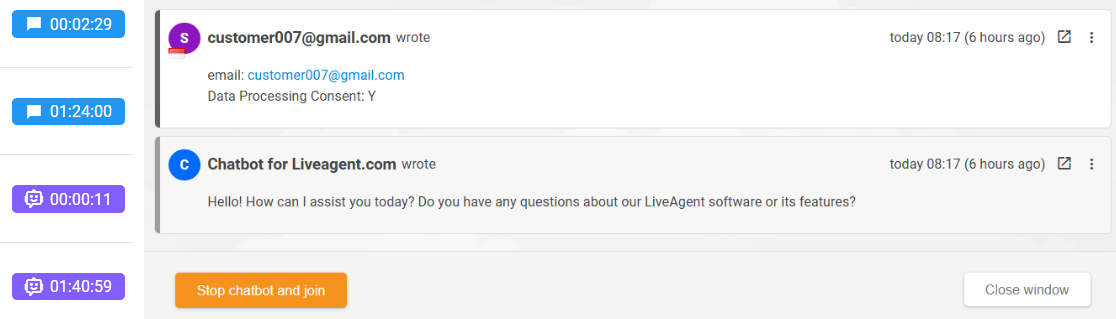
This is also the step where chatbots that live inside a help desk tend to have an edge over standalone bots. The LiveAgent AI Chatbot , for instance, sits next to ticketing and CRM data by default, so questions like order status or refund eligibility don’t rely on a separate integration working correctly.

The latest tips and deals delivered straight to your inbox.
Almost every vendor offers a free trial or pilot period. Use it deliberately instead of just poking around.
In the first week, test:
A short, focused pilot with your own data will tell you more in a week than any sales call will in a month.
Some warning signs are easy to miss in a polished sales demo but tend to cause real problems after signing:
If you notice more than one of these during a demo, treat it as a reason to ask harder questions, not necessarily a reason to walk away. But don’t ignore them either.
The chatbot evaluation criteria below turn everything in this guide into a simple scorecard. Use it to compare shortlisted tools side by side. Score each category from 1 (poor fit) to 5 (excellent fit) based on what you learned in the steps above.
| Category | What to check | Score (1-5) |
|---|---|---|
| Use case fit | Handles your top one or two priority use cases well | |
| Channel coverage | Works across the channels where your volume actually sits | |
| Total cost | Includes AI features, channels, and overage costs in the estimate | |
| Integrations | Connects meaningfully with your help desk, CRM, and e-commerce | |
| Pilot accuracy | Answered real customer questions correctly during testing | |
| Escalation | Hands off to a human cleanly when it can’t help | |
| Setup time | Matches the vendor’s advertised timeline | |
| Reporting | Gives visibility into resolution and satisfaction rates |
Add up the scores. A tool that scores well across the board, rather than one that scores a perfect 5 on a single flashy feature, is usually the safer long-term pick.
Choosing an AI chatbot isn’t about finding the tool with the longest feature list. It’s about matching a tool to your team size, your ticket volume, and the channels your customers already use. Once you’ve worked through your use case, budget, and integration needs, a side-by-side comparison of the top AI chatbots for 2026 becomes a much faster read, because you’ll already know exactly what you’re looking for.
If you’d like to see how this checklist plays out with a real tool, the LiveAgent AI Chatbot runs inside a full help desk, so you can test integrations, escalation, and reporting all in one place during your trial. You can also check how LiveAgent stacks up against other options in this AI chatbot comparison for 2026 .
Share this article
Compare the top AI chatbots for 2026—ChatGPT, LiveAgent, Gemini & more—by features and pricing to find the best AI chatbot for your business.
LiveAgent, Intercom Fin, and Zendesk AI chatbots compared on setup time, training, escalation logic, and total cost for a 20-agent team in 2026.

Six real AI chatbot deployments in customer service, from Klarna to IBM, with the actual numbers, what to watch for, and the pattern behind the ones that worked...