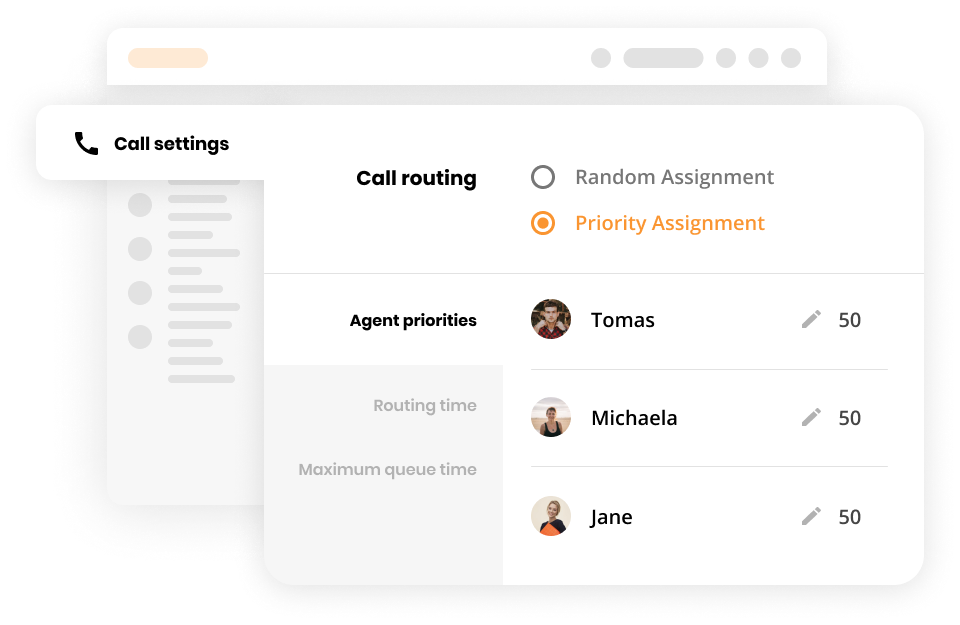
Automatic call distribution makes sure every incoming call reaches an agent who is free, in a fair order, without anyone forwarding calls by hand. Automatic call distribution is the method and an automatic call distributor is the system that does it; both are shortened to ACD.
How does automatic call distribution work?
Automatic call distribution works in four steps: it identifies the call, places it in a queue, picks an available agent by its rule, and moves the call on if that agent does not answer.
-
Identify the call
The system reads the caller’s number and the number that was dialed, and, if there is an IVR menu, the option the caller chose. That decides which queue or team the call belongs to.
-
Queue the caller
If no agent is free, the caller waits in the queue in the order they called, with music or a message. Some systems move priority callers ahead.
-
Pick an agent by the rule
When an agent is free, the distribution method decides who gets the call: the next in a fixed list, the one who has waited longest, the one with the highest priority, or everyone at once.
Reroute or overflow
If the agent does not answer within a set time, the call goes to the next agent. If the queue takes too long, the call moves to voicemail, another number or a callback.
What are the call distribution methods?
The most common call distribution methods are fixed order, round robin, longest idle, ring all, priority and skills-based distribution; they differ in who gets the next call:
| Method | Who gets the next call | Good for |
|---|---|---|
| Random | Any free agent, picked at random | Teams where agents are interchangeable |
| Fixed order (linear) | The first free agent in the same list every time | A clear first line with backup agents |
| Round robin (circular) | The next agent after the one who took the last call | Spreading calls evenly |
| Longest idle (uniform) | The free agent who has waited longest since their last call | Fair workload in busy teams |
| Ring all (simultaneous) | Every free agent at once; the first to answer takes it | Very small teams that want the fastest pickup |
| Priority (weighted) | The free agent with the highest priority, then the longest idle | Sending calls to senior agents first |
| Skills-based | The free agent whose skills match the call, such as language or product | Teams whose agents really differ |
For example, Anna, Ben and Cara are free. Ben’s last call ended 4 minutes ago, Anna’s 2 minutes ago and Cara’s 30 seconds ago. With longest idle the next call goes to Ben; with fixed order it goes to whoever is first on the list; with ring all, all three phones ring.
Time of day, the caller’s number or a VIP flag can change the rule, for example sending calls outside business hours to voicemail or VIP callers to a dedicated team.
What is the difference between ACD and IVR?
An IVR asks the caller where they want to go, and ACD then decides which agent in that team takes the call. IVR (interactive voice response) is the phone menu: “Press 1 for billing, 2 for technical support.” It can also answer simple questions without an agent. ACD comes after the menu: it queues the call and gives it to a free agent by its rule. A small team often needs ACD first and an IVR only once it has more than one team or many repeated questions.
| IVR | ACD | |
|---|---|---|
| Question it answers | Where does the caller want to go? | Which agent takes the call? |
| Who decides | The caller, by keypad or voice | The system, by a set rule |
| Works without agents | Yes, for self-service answers | No, it distributes calls to agents |
Call routing is the broader term: it covers the IVR, ACD and any rule that sends a call somewhere, such as forwarding to a mobile phone. A PBX is different again: it connects a call to the extension that was dialed, while ACD shares calls to one number among a group of agents.
Why does automatic call distribution matter?
Automatic call distribution matters because it decides how long callers wait and how evenly agents share the work: without it, calls ring the wrong person, wait unseen or go to whoever happens to pick up.
- Shorter waits. A queue with a fair order answers callers as soon as anyone is free and shows how many are waiting.
- Fair workload. Longest-idle or round-robin distribution stops the fastest agent from taking every call.
- Fewer transfers. Calls that reach the right team first do not have to be passed on, which helps first call resolution.
- Measurable service. A queue gives you wait times, missed calls and average handle time to report on. The traditional call center target is 80% of calls answered within 20 seconds; SQM Group suggests 120 seconds instead, because it found no drop in satisfaction before then.
How should a small support team set up call distribution?
A small team should start with one queue per team, a fair distribution method and a clear plan for calls nobody can answer:
- One number, one queue per team. Add an IVR menu only when callers need to choose between teams.
- Longest idle or priority. Use priority to send calls to experienced agents first and longest idle to share the rest fairly.
- A short reroute time. About 20 to 30 seconds of ringing before the call moves to the next agent keeps callers from waiting on an absent agent.
- A plan for overflow. Decide what happens after the maximum queue time: voicemail, a mobile number or an automatic callback.
- A check every week. Look at call volume by hour, missed calls and wait times, and move agents to the busy hours.
What are common ACD mistakes?
The most common mistake is keeping ring all after the team grows past three or four agents: agents interrupt each other and nobody owns the waiting callers.
- No overflow plan. Callers who wait without end hang up; set a maximum queue time and say what happens next.
- Too long a ring time. A call that rings an absent agent for a minute before moving on wastes the caller’s time.
- Unclear IVR options. If callers pick the wrong menu option, ACD sends them to the wrong team, however good the rule.
- Skills nobody maintains. Skills-based routing only works while the skills are kept up to date; otherwise it sends calls to the wrong people.
- Ignoring other channels. Chats and emails need the same fair distribution, or agents on the phone also end up with all the chats.
Automatic call distribution in LiveAgent