Average handle time tells you how much agent time one customer contact takes, which makes it the starting point for staffing and for finding work that slows your team down. Average handle time and average handling time are two names for the same metric, shortened to AHT; in phone support it is also called call handling time.
How do you calculate average handle time?
To calculate average handle time, add up talk time, hold time and after-contact work for a period and divide the total by the number of contacts handled in that period.
Average handle time
ACW is after-contact work. Some benchmarks leave hold time out: say which version you use and keep it, so your numbers stay comparable.
Example: In one week your team handles 1,200 calls with 80 hours of talk time, 10 hours of hold time and 30 hours of after-call work: 120 hours, or 7,200 minutes ÷ 1,200 calls = 6 minutes per call.
Benchmark: About 7 minutes is the call center average, counting talk time, hold time and after-call work. Source: SQM Group, 7 essential customer service metrics, December 2022
The three parts are measured the same way in every channel:
- Talk time: the conversation itself, on the phone or in the chat window.
- Hold time: time the customer waits during the contact while the agent checks something or asks a colleague.
- After-contact work (ACW): what the agent does once the customer has gone, such as notes, tags, a follow-up task or a ticket update. Call centers call it after-call work or wrap-up time.
For email and tickets, count the time agents actually work on the ticket across all its replies, not the hours or days it stays open.
What is a good average handle time?
A good average handle time for a call center is about 7 minutes per call, counting talk, hold and after-call work (SQM Group); IT service desks take 10 to 14 minutes per contact. There is no single industry standard, because handle time depends on what customers ask about and on the channel, and the often-quoted 6 minutes 10 seconds has no traceable source:
| Dataset | Average handle time |
|---|---|
| Call centers, talk + hold + after-call work (SQM Group, 2022) | 7 min |
| IT service desks, phone, 2023 (MetricNet) | 10.8 min |
| IT service desks, chat, 2023 (MetricNet) | 13.4 min |
| IT service desks, email and web tickets, 2023 (MetricNet) | 13.7 min |
Sources: SQM Group, December 2022; MetricNet, Summary of 2023 IT Service and Support Benchmarks.
A good AHT for your team is one that stays steady while first call resolution and customer satisfaction stay high; compare your own trend by contact type rather than with someone else’s average.
Why does average handle time matter?
Average handle time is one of the core call center KPIs (key performance indicators) because it decides how much work your contacts create, and so how many agents you need: 1,200 calls a week at 6 minutes each is 120 hours of handling, about three full-time agents before breaks and time between calls.
- Staffing. Contacts multiplied by AHT gives the workload; a change of one minute per contact changes it by a sixth at 6 minutes.
- Finding slow work. A contact type that takes twice as long as the rest usually points to a missing answer, a slow tool or a process that needs approval.
- Cost per contact. Agent time is most of what a contact costs, so AHT shows where the money goes.
Handle time and quality pull against each other. Pushing agents to finish faster can lower first call resolution, and every repeat contact adds its own handle time.
How do you measure average handle time in a small support team?
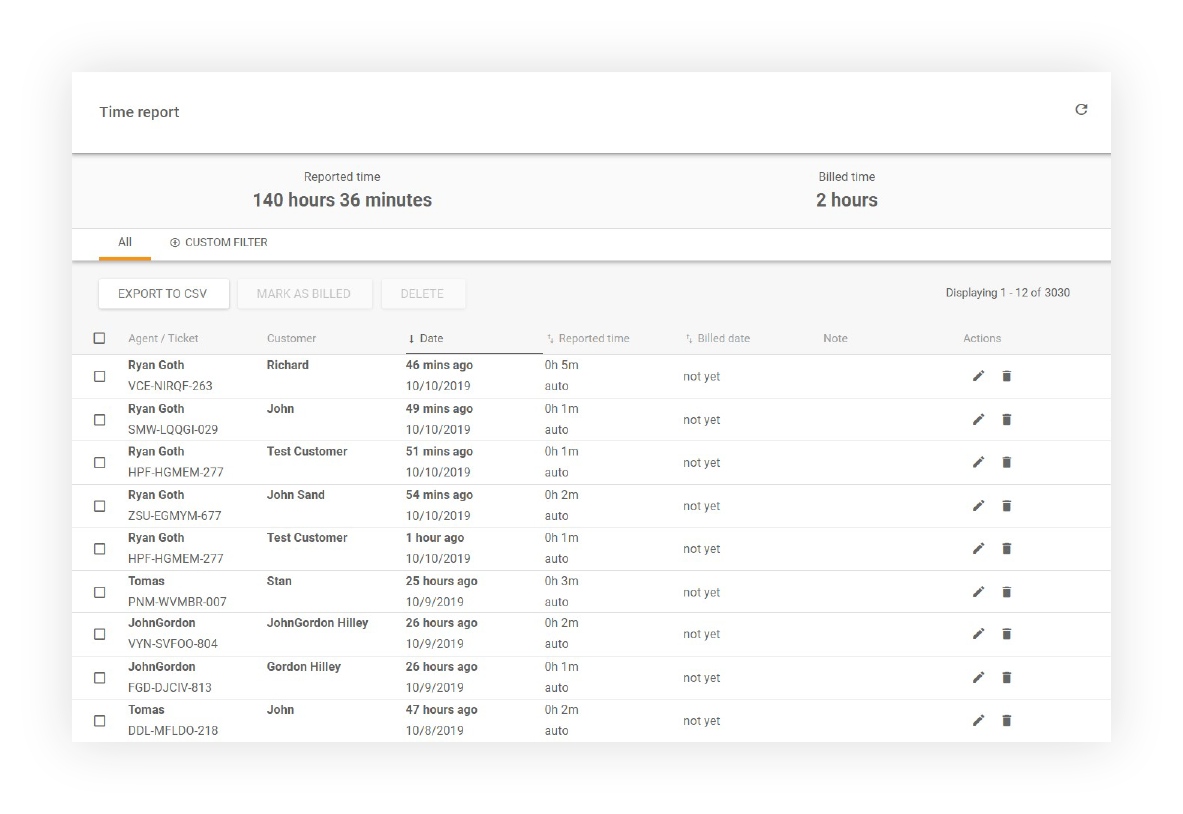
A small team can measure average handle time from the times its help desk or phone system already records: agree what counts, read the times per channel and contact type, and review them weekly with resolution and satisfaction.
-
Decide what counts
Write down whether you include hold time and after-contact work, and for tickets whether you count time worked or time open. Keep the rule fixed.
-
Take times from the system
Use the call durations and tracked time your software records instead of agents’ estimates, which are usually too low.
-
Split by channel and contact type
Report phone, chat and email separately, and look at the most common request types on their own, so one long type does not hide in the average.
Review weekly with quality
Read AHT next to first call resolution and customer ratings, and look at the slowest contacts to see what took the time.
What are common average handle time mistakes?
The most common mistake is making AHT an agent target: agents then hurry customers or end contacts early, and the issues come back as repeat contacts.
- Leaving out after-contact work. AHT looks better, but the work still happens and still needs staff.
- Mixing channels. Phone, chat and email take different amounts of time, so one average for all of them describes none.
- Averaging very different contacts. A password reset and a billing dispute belong in separate numbers.
- Comparing with an “industry standard”. There is none; a widely quoted figure of 6 minutes 10 seconds has no traceable source.
- Ignoring concurrent chats. An agent running three chats at once has a longer AHT per chat but handles more customers per hour.
How is average handle time different from talk time, call time and resolution time?
Average handle time counts all the work on one contact; talk time counts only the conversation, call time adds hold time, and resolution time measures how long the customer waits for a solution:
| Metric | What it counts | What it shows |
|---|---|---|
| Average handle time | Talk time, hold time and after-contact work, per contact | How much agent time a contact takes |
| Talk time | The conversation only | How long agents talk with customers |
| Call time | Talk time and hold time, without wrap-up | How long the customer is on the line |
| Resolution time | Elapsed time from the request to the solution, waiting included | How long the customer waits for an answer |
How can a small support team reduce average handle time?
A small team reduces average handle time best by removing work from each contact rather than by hurrying customers:
- Keep answers in one place. A knowledge base and saved replies spare agents from searching or typing the same answer again.
- Show the customer’s history. Earlier conversations on screen save the questions the customer has already answered.
- Send each contact to the right person. Call routing to the right department avoids transfers and repeated explanations.
- Shorten after-contact work. Fixed tags and short note templates turn wrap-up into a few clicks.
Seven tested changes, and how to check they worked, are in the guide how to reduce average handle time.
Average handle time in LiveAgent