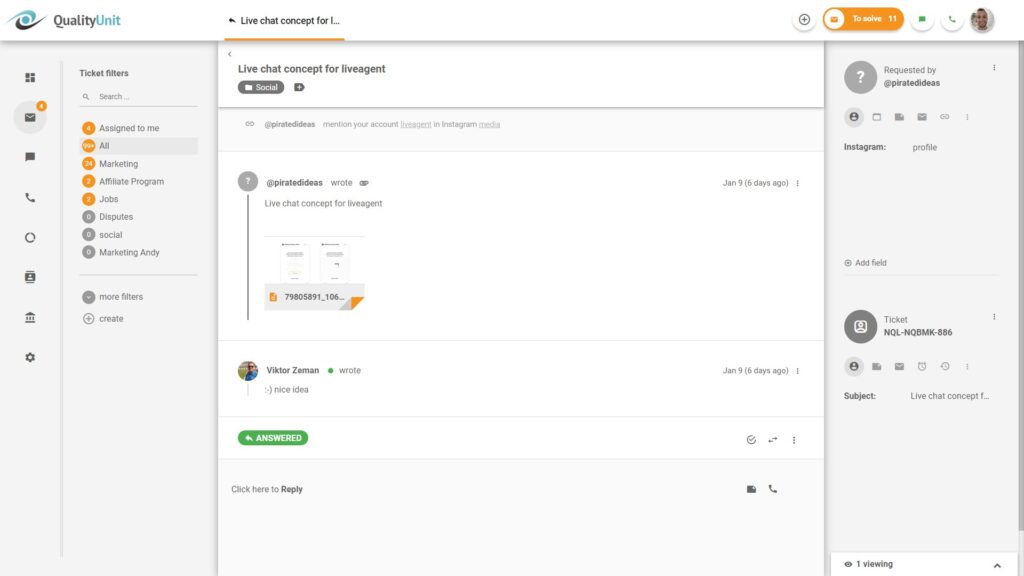
LiveAgent offers ready-made social media customer service templates to efficiently handle complaints and mentions. Key tips include responding promptly, not deleting negative comments, and knowing when to take conversations offline.
Social media customer service is repetitive — the same questions and requests pop up over and over again. Typing out the same response every time is tiring, time-consuming, and overwhelming routine work that can be avoided by using pre-defined replies. Below are some hands-on tips along with ready-made social media service templates that you can adapt, personalize, and use whenever your customers turn to social media for customer support.
Best practices for responding to social media mentions and comments
Don’t ignore customer complaints
Nearly 70% of complaints made by customers on social media are ignored. Take advantage of social media monitoring tools that make it easier to keep track of all brand mentions, comments, and messages as soon as they appear.
Respond immediately (speed matters in social support)
Since social media is seen as an ‘always-on" platform, consumers naturally expect brands to respond as quickly as possible. According to a study by The Social Habit, 42% of consumers expect a response on social media within 60 minutes, and 32% expect a response within 30 minutes.
Don’t delete (or hide) negative comments
Deleting a negative comment in order to preserve your virtual image will only further frustrate a complainer and damage the relationship you have with them. The only exception is when comments clearly spam or in violation of posted community guidelines.
Sense the tone
Use the right tone of voice that is tailored to match each particular case. Does the customer use casual language and slang? It might be okay to reciprocate. Does the customer sound frustrated? It’s better to use a tone that’s empathetic and reassuring. JetBlue is an example of a brand that does it really well.
You don’t always need to respond to everyone
In case of mass issues or outages, there is no need to respond to every message as it would be extremely time-consuming and ineffective. When many customers are affected by a single issue, it makes sense to provide only public status updates that will reach everyone.
Know when to take it ‘offline’
Not every conversation on social media has to be public. Switching to private messaging works best when you need customer’s personal information (email, order number, etc.), a thorough explanation of the issue to assist them, or if the conversation is getting tense.
Join our newsletter
The latest tips and deals delivered straight to your inbox.
Social media customer service response template examples
Responding to information requests
@name, thanks for reaching out. We have many different plans, so please email our billing team at (email address) and our agents will be happy to help you with any pricing information you need and will advise on the best plan for your business.
@name, we’ve got your back! Check out this article to get your software up and running: (link). If anything is still unclear, just let us know, we’ll be happy to help.
Hello @name, thanks for your interest in our services. If you provide us with your e-mail address, we can send you comprehensive information on our offers and prices.
@name, thanks for reaching out. Yes, we offer (services). If you provide us with your e-mail address we will be glad to send you comprehensive information on the terms and conditions of service as well as our prices.
Thank you for your inquiry. Today we’re open from 9:00 am to 6:00 pm. We are looking forward to your visit.
Our office is closed from the 23rd- 25th of December. Afterwards we are there for you again. Are there any other questions I may help you with?
Responding to service requests
Hello @name, thank you for your inquiry. We will look into your problem and contact you immediately with a resolution. Regards, (Name).
@name, I apologize for the delay. We have received your information and we are working to get your order to you as soon as possible. Thank you for your patience.
Hi @name, thanks for letting us know about this. Please DM us more details about the issue, so we can take a look into this for you right away.
Hey @name, thanks for informing us know about this issue. We’ll make sure this gets shared with the right people here at (Company). I’ll let you know as soon as it’s fixed.
That’s certainly not what we like to hear, @name. Please DM us your order confirmation number so we can follow-up with you. – (Name)
Hey @name, really sorry for the trouble here. I’m going to escalate this to our tech support team to see if we can figure out the issue and get it fixed ASAP! – (Name)
@name, my sincerest apologies! I would be happy to look into this for you. Can you please follow us and DM me with your order number? – (Name)
Responding to positive comments
Hello @name. We are happy you were satisfied with our service. If you’d like you can leave a review [here] and help others with your recommendation. Thanks!
Thanks for the shout-out! We’re happy to have you in the (Company) family!
Thank you for buying your (product) from us, @name. We look forward to seeing you again soon!
We at (company name) know you had many options to choose from, so thank you for choosing us. We sincerely hope you are satisfied with your purchase.
@name, we’re happy to know your experience was awesome and we can’t wait to see you again soon!
@name, your feedback is incredible; thank you for sharing that with us! It’s wonderful that (product) has made such a difference for you.
Responding to positive reviews
Thank you for your fantastic review, @name. We are thrilled that you loved your experience and look forward to seeing you again.
Thank you so much for taking the time to leave us this amazing review, @name. We’re so lucky to have customers like you!
@name, your awesome review made our day! Thank you for taking the time to share it with us and the community.
We are incredibly grateful that you took the time out to leave us this great review, @name. Thanks for being such a fantastic customer!
@name, we are truly happy to know your experience was tremendously delightful. It’s something we’ve worked hard on and we’re pleased our efforts resonated with you.
We’re happy you had a fantastic time with us, @name! Thanks for your trust, we’re thankful for amazing customers like you. We hope to see you again soon!
@name, it’s always a pleasure seeing you. Thanks so much for your feedback and good vibes. We’re happy that you’re happy, and we’re looking forward to your next visit. Hurry back!
We’re so glad you had a good experience, @name. We work really hard to provide the best service to our guests, so I’m happy to see that reflected on your last visit. I made sure that (employee name) got the recognition she deserved. She was really happy to see your review. – (Name)
Hi @name, we are thrilled to have you as part of the (Company) family! Thank you for leaving an amazing review. It means the world to us and to our entire team! We look forward to serving you again soon!
Hello @name, thank you for the wonderful review and for taking the time to share your feedback with (Company). Excellent customer service is our priority and we are happy that we met that mark! Customers like you make our job a pleasure.
Responding to customer complaints
Hello @name. We are very sorry that you were not satisfied with our service. Since customer satisfaction is our top priority, we will reach out to you personally to discuss a solution to your problem together. Best, (Name).
Oh no! We’re so sorry to hear this but appreciate you letting us know. This is not the norm and we’re happy to help. Please contact our customer care team for assistance at (email).
@name, we’re so sorry to hear you were unsatisfied with your purchase. If you’re interested in some return/ exchange options, please give us a call at (number, 8 am – 11 pm, 7 days a week), and we’ll do our best to help.
@name, so sorry about that. We always hate it when that happens. Send us a DM with your confirmation code and we’ll send you credit for the non-working (item).
@name, my apologies for the inconvenience! I just reached out to you via Facebook Messenger to discuss it further. Be sure to check your ‘Message Requests" folder. – (Name)
Responding to negative reviews
Hi @name. We’re sorry to hear your experience was less than 5-stars. If you’re open to discussing your experience further, please call /email us at (number/ email).
@name, sorry about your negative experience. We’re normally known for our exceptional attention to detail, and we regret that we missed the mark.
Hi @name, we apologize for your negative experience. We’d like to learn more about your specific situation and make things right. If you wouldn’t mind give us a call at (number), that would be greatly appreciated. We look forward to speaking with you and working towards earning back your business.
Hello @name, I’m sorry to hear about your disappointment with us, and I would like to personally assist you with making things right. Let’s get on a call and address this ASAP, we value your business. Please contact us at (phone) when convenient.
@name, thank you for bringing this to our attention. We’re sorry to hear of your less than satisfactory experience and hope you will accept our sincerest apologies. Please give us a (call/email) to see how we can make things right.
Ending a conversation and following up
@name, happy to hear you’re back in action. Give us a shout if you need anything else.
I’m glad to know your (items) finally came through, @name, thank you for letting us know. I apologize for the painfully slow process it took to get them. We never intended for this to happen.
@name, I’m happy that we were able to help you resolve your problem. I’ll be sure to relay your message to (employee name). – (Name)
@name, I’m happy you’re pleased with the results and that we were able to sort this out. If there’s anything else we can do to help, please let us know. Best, (Name).
Thank you for giving us the opportunity to help out, we’re here if you ever need us again!
Hello @name, we haven’t heard back from you. Were you able to get the assistance needed? If you still need help, please provide the details previously requested. Thanks! – (Name)
Why your business cannot ignore social media customer service
67% of consumers use social media networks like Twitter and Facebook to seek resolution for issues, and nearly 70% reported they have used social media for customer service on at least one occasion.
63% of consumers actually expect companies to offer customer service via their social media channels, and 90% of social media users have already used social media as a way to communicate with a brand or business.
When consumers reach out to a brand on social media, 40% expect brands to respond within the first hour, while 79% expect a response in the first 24 hours.
71% of consumers who have had a positive experience with a brand on social media are likely to recommend the brand to their friends and family.
One-third of all customer complaints are never answered, most of them on social media. Answering a complaint increases customer advocacy by 25%, while not answering a complaint decreases customer advocacy by 50%.
77% of Twitter users feel more positive about a brand when their Tweet has been replied to. Companies using Twitter for customer service see a 19% lift in customer satisfaction.
The best way to manage social media customer service is to connect it with your help desk software. As a result, your agents will be able to effectively and efficiently handle all kinds of inquiries from one interface.
In general, companies should aim to engage with and address customer comments on social media, as it demonstrates responsiveness and a commitment to customer satisfaction. However, it's not always possible to respond to every single comment. Companies should prioritize responding to comments that raise valid concerns, require assistance, or present an opportunity for meaningful engagement.
Negative comments from customers can affect the success of your business. If you're a company representative, you should handle negative comments on social media by acknowledging the complaint, providing a solution, and never taking things personally.
Good customer service on social media requires setting clear response times, separating customer service inquiries from regular posts, actively seeking feedback, and addressing customer concerns. Use templates for common queries, integrate chatbots for immediate assistance, and take complex conversations private if needed. Utilize tools such as Hootsuite or LiveAgent to streamline the process and constantly adapt strategies to meet evolving customer expectations. Analyze feedback to continually improve services. Always maintain a professional and personal tone.
Customer care is the provision of services to customers before, during, or after the sale of a product. On the other hand, it can also be a department within a company that is responsible for this.
Learn to manage social media complaints with apology templates and feedback strategies. Use our templates to address issues, restore trust, and enhance customer...
Opening Hours/Service Times Question Reply Templates
Learn to deliver exceptional social media customer service with predefined reply templates for opening hours. Enhance efficiency, optimize resources, and improv...
Master social media customer service in 2024! Learn best practices, tools, and tips to deliver fast, tailored, and impactful support across Facebook, Twitter, I...
18 min read
Social media customer service
Customer service best practices
+1
Cookie Consent We use cookies to enhance your browsing experience and analyze our traffic. See our privacy policy.